A retaining wall project at a new commercial site off Pleasant Grove Boulevard hit weathered granite at just 8 feet. The contractor called our lab. We pulled the grain-size curve and Atterbergs within 48 hours. Roseville sits on a mix of residual granite soils and alluvial deposits from the Dry Creek watershed. You hit competent rock fast in some areas. In others you deal with loose silty sands for 20 feet before reaching anything solid. Anchor design here is not a catalog exercise. We run direct shear on the soil. We measure the unit weight. Then we feed real parameters into the load-transfer models. That is how you size the bond length for a tieback anchor without overdesigning. When the project requires proof of rock capacity, we also run unconfined compression on the bedrock core. The data drives the design. No guesswork. That is how Roseville projects stay on schedule and on budget.
An anchor is only as reliable as the soil parameters you plug into the load-transfer analysis. We measure those parameters.
Our approach and scope
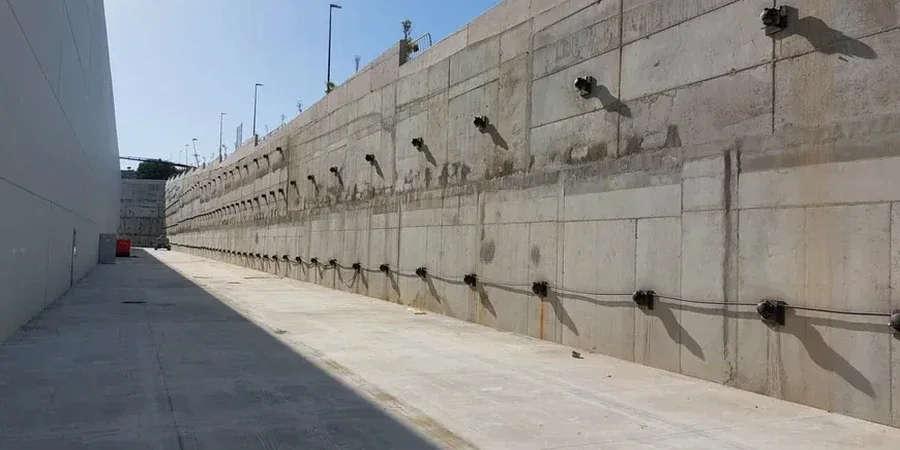
Local ground factors
Roseville grew fast after the 1990s. Areas that were open fields became subdivisions in 24 months. The fill history is not always documented. We have seen construction debris under what looked like native soil. A passive anchor installed through a fill pocket without proper investigation will creep. That is not an opinion. It is a fact of soil mechanics. The bond stress in uncontrolled fill is unpredictable. We push CPT testing in the anchor alignment to detect fill layers and soft lenses before the design is finalized. Another risk is groundwater. Roseville's water table fluctuates with releases from Folsom Lake and irrigation return. A saturated backfill behind a wall doubles the lateral pressure on the anchor head. We measure the permeability and include a drainage specification. The cost of ignoring these risks is a wall that moves. Repairing a failed anchor is ten times the cost of proper upfront testing. The investment is in certainty.
Standards that apply
ASTM D2487 – Soil Classification, ASTM D3080 – Direct Shear Test, ASTM D4767 – Consolidated Drained Triaxial Test, 2022 California Building Code (CBC) with Roseville amendments, PTI DC35.1 – Recommendations for Prestressed Rock and Soil Anchors
Complementary services
Active Anchor Design Parameters
We supply the drained and undrained strength parameters for the bonded length design. For rock anchors, we run unconfined compression on the core. The report includes the soil-grout bond stress recommendation based on the fines content and plasticity of the in-situ material.
Passive Anchor & Deadman Evaluation
Passive anchors rely on the passive earth pressure in front of the anchor block. We measure the friction angle and unit weight of the soil in that zone. We also test for expansive potential to ensure the passive resistance does not degrade over seasonal wet-dry cycles.
Typical parameters
Quick answers
What does active/passive anchor design testing cost in Roseville?
A typical anchor investigation program in Roseville ranges from US$1,000 to US$3,660 depending on the number of borings and the lab tests required. A single tieback wall with two borings and direct shear testing runs near the lower end. A project requiring rock coring, triaxial tests, and multiple anchor alignments will be at the upper end. We supply a fixed-price quote after reviewing the wall plans.
What soil tests are mandatory for an anchored retaining wall in Roseville?
The Roseville building department requires a geotechnical investigation per the California Building Code. At minimum you need soil classification (ASTM D2487), unit weight determination, and drained shear strength testing. If the anchor bond zone is in rock, unconfined compression tests on the core are required. We also recommend Atterberg limits to check for expansive clay.
How deep do you need to investigate for an anchor design?
The investigation depth must extend at least 10 feet below the deepest anchor bond zone. For a tieback anchor with a 30-foot-deep bond zone, we drill to 40 feet minimum. In Roseville's granite terrain, we core 5 feet into competent rock when the anchor is socketed into bedrock. The exact depth is determined during the field exploration.
Can you test the anchor after installation?
We do not perform the field proof testing ourselves. We supply the soil parameters that the anchor supplier uses to calculate the lock-off load and the proof test criteria. The anchor contractor performs the pull test on site. We can recommend qualified specialty contractors in the Roseville area who handle the installation and testing phase.