Retaining wall design in Roseville isn't something you can pull off with a generic catalog detail. The IBC and ASCE 7-22 set the baseline, but the real challenge is what lies beneath the surface: the Mehrten Formation's weathered claystone mixed with pockets of loose alluvium. We've seen too many walls lean or crack within three years because the design ignored the swell potential of the local clay. Our team runs the lab tests that matter—unconfined compression, direct shear, consolidation curves—and feeds the numbers straight into the wall geometry. When the site sits near Dry Creek or one of the city's many drainage corridors, we often pair the retaining wall design with a slope stability analysis to make sure the global failure surface doesn't bypass the wall entirely. You get a stamped calculation package that Roseville's building department accepts without back-and-forth.
A retaining wall is only as good as the soil data behind it—skip the lab, and you're designing blind.
Our approach and scope
Local ground factors
A builder we worked with on a project near Sierra College Boulevard had a 9-foot wall that tilted forward just one winter after construction. The culprit wasn't the wall stem—it was the backfill. The contractor had used on-site silty clay, and the drainage system clogged within months. Hydrostatic pressure built up, and the wall rotated. We got called in to redesign the repair: a full-height reconstruction with a granular chimney drain and a key-in to competent claystone. That single failure cost the owner nearly triple the original wall budget. In Roseville's climate, where winter storms can dump 3 inches of rain in 24 hours, the drainage behind a retaining wall isn't optional—it's the primary defense. We also check for expansive soil pressure when the retained material is native clay; that's a load case most standard software doesn't capture unless you override the defaults.
Watch the video
Standards that apply
IBC 2021 (California amendments, Title 24), ASCE 7-22 Minimum Design Loads for Buildings and Other Structures, Caltrans Standard Specifications Section 19 (Earthwork), ASTM D2487 (Unified Soil Classification System), ASTM D1586 (Standard Penetration Test)
Complementary services
Geotechnical Retaining Wall Design Package
Complete design including site investigation, lab testing for shear strength and consolidation, wall type selection, global and internal stability checks (sliding, overturning, bearing), drainage design, and construction specifications. Stamped by a California-licensed geotechnical engineer.
Forensic Wall Assessment & Repair Design
Investigation of distressed or failed retaining walls. We map cracks, measure tilt, excavate test pits to expose the backfill and drainage condition, and develop a repair plan—whether it's tieback anchors, toe reinforcement, or full reconstruction.
Typical parameters
Quick answers
What does a retaining wall design cost in Roseville?
For a typical residential wall up to 6 feet tall, the geotechnical investigation and design package runs between US$1,140 and US$3,920. Taller walls, tiered systems, or walls requiring deep foundations push toward the upper end due to additional borings and more complex stability modeling.
How deep do you drill to get soil data for the wall?
We typically drill to a depth of 1.5 to 2 times the wall height below the proposed footing elevation. For a 10-foot wall, that means 15 to 20 feet of exploration. If bedrock is shallower, we core into it to verify it's competent and not just a boulder.
Do I need a permit for a retaining wall in Roseville?
Yes, the City of Roseville requires a building permit for any retaining wall over 3 feet in height, and walls supporting a surcharge (like a driveway) need a permit regardless of height. Our stamped plans satisfy the city's submittal requirements.
What's the difference between an MSE wall and a cantilever wall?
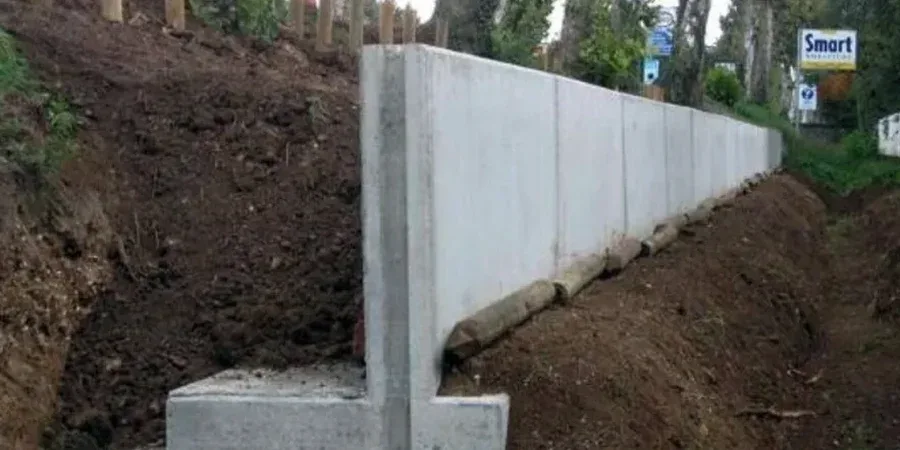
A cantilever wall resists soil pressure through its own weight and the weight of soil on the heel slab, relying on a rigid reinforced concrete stem. An MSE wall uses alternating layers of compacted granular fill and geogrid reinforcement to create a composite mass. We choose based on cut height, available space, and aesthetics.
How long does the design process take?
From the day we mobilize the drill rig to the day you get the final stamped package, plan on 3 to 4 weeks. Lab testing takes the bulk of that time—consolidation tests run 5 to 7 days by themselves. We can expedite for a surcharge if your schedule is tight.