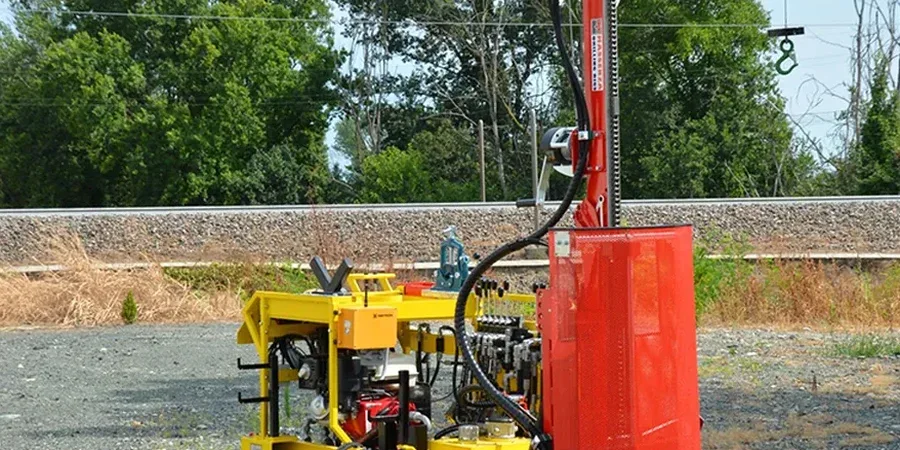
In Roseville, the contrast between granitic foothills and deep alluvial deposits along Dry Creek means you can hit refusal at 15 feet on one lot and drill past 60 feet in the next. That variability makes the Standard Penetration Test essential for any project requiring accurate N-value data. Our crews run a 140-lb safety hammer with an automatic trip on a CME-75 drill rig, following ASTM D1586 procedures to the letter. Whether it is a commercial pad near the Galleria Mall or a hillside retaining wall in West Roseville, the stratigraphy here demands careful blow count interpretation — especially in the transition zones where weathered rock meets colluvium. We pair SPT sampling with grain size analysis to verify classification of the silty sands common in Placer County, and when stratigraphy gets erratic we recommend supplementing with CPT soundings for continuous profiling without sample disturbance.
In Roseville's mixed geology, N60 values under 8 in saturated sands below 25 feet are a red flag for liquefaction that no amount of foundation overdesign can ignore.
Our approach and scope
Local ground factors
Roseville sits roughly 80 miles east of the San Andreas Fault and 40 miles west of the Sierra Nevada frontal fault system, placing it in Seismic Design Category D per ASCE 7. The mapped VS30 values across the city range from 250 m/s in the deeper basin areas near the Sacramento County line to over 760 m/s on the granitic outcrops east of Foothills Boulevard. Projects that skip SPT investigation in the low-VS30 zones risk missing liquefiable layers that the 2014 South Napa earthquake proved can amplify shaking well beyond design assumptions. The California Geological Survey Seismic Hazard Zone maps flag portions of western Roseville for liquefaction potential — and the only way to clear or confirm that designation on your specific parcel is with field blow counts from a properly calibrated SPT program. Losing a foundation to differential settlement after a moderate event costs exponentially more than the drilling.
Standards that apply
ASTM D1586-22 (Standard Test Method for SPT), ASTM D2487-17 (Unified Soil Classification System), ASCE 7-22 (Minimum Design Loads for Buildings), IBC 2024 (International Building Code), California Building Code (CBC) Title 24, ASTM D4633-16 (Hammer Energy Calibration)
Complementary services
SPT Drilling with Hollow-Stem Auger
Truck-mounted CME-75 rig with auto-trip safety hammer. Continuous sampling at 5-foot intervals or at stratum changes, with real-time N-value logging.
In-Situ Permeability Testing
Falling-head or constant-head permeability tests conducted in SPT boreholes to estimate hydraulic conductivity in granular layers for dewatering design.
Laboratory Classification Suite
Grain size distribution, Atterberg limits, and moisture content on SPT samples. Classification per ASTM D2487 with written log and photo documentation.
Liquefaction Triggering Analysis
Seed-Idriss simplified procedure and Boulanger-Idriss (2014) update using N60 values from SPT. Factor of safety against liquefaction calculated per ASCE 7-22.
Typical parameters
Quick answers
How much does an SPT borehole cost in Roseville, California?
SPT drilling in Roseville typically ranges from US$480 to US$760 per borehole, depending on depth, access conditions, and traffic control requirements. Shallow borings under 30 feet in open lots fall at the lower end. Deeper holes, sites requiring a traffic control plan near Roseville Parkway, or locations with difficult drill access push toward the higher end. Mobilization is quoted separately based on distance from our yard.
What depth do you typically drill for an SPT investigation in Roseville?
For single-family residential pads we usually drill to 25-35 feet, or until refusal on competent granite. Commercial and multi-story projects in Roseville commonly require 50-60 feet, particularly in the alluvial basin west of Highway 65 where deeper liquefiable layers are present. We follow the IBC requirement of exploring to a depth where the stress increase from the foundation is less than 10% of the existing overburden pressure.
How does Roseville's geology affect SPT blow counts?
The Mehrten Formation and younger alluvial deposits across Roseville produce highly variable N-values. Clean gravels east of Foothills Boulevard can yield N60 above 50, while the loose silty sands along Dry Creek corridors often record N60 between 6 and 15. The transition zone where decomposed granite meets colluvium — common in the West Roseville hillside developments — frequently shows erratic blow counts that require careful interpretation and correlation with laboratory classification.
Do you need permits for SPT drilling in Roseville?
Most SPT drilling in Roseville requires a Placer County drilling permit and, if the site is in the public right-of-way, an encroachment permit from the City of Roseville Public Works Department. Underground Service Alert (USA North 811) must be notified at least two working days before mobilization. We handle the permit coordination as part of the drilling program.