We were reviewing soil reports for a commercial development along Douglas Boulevard last year when the cores showed exactly what makes Roseville geology so interesting: 15 feet of stiff clay over dense gravel, with groundwater showing up at 22 feet. The structural engineer had specified shallow footings, but the plasticity index on that upper clay layer was running 28 to 32. That's the kind of profile where plate load test data becomes essential before committing to a pile design — you need to know what the bearing stratum is actually going to give you, not just what the textbook says. Roseville sits on a mix of Pleistocene-age alluvial fan deposits coming off the Sierra foothills, and the stratigraphy can change within a few hundred feet of lateral distance. One lot will hit competent gravel at 18 feet; the next one over might need piles driven to 45 feet through alternating lenses of silty sand and fat clay. We've designed pile foundations for everything from tilt-up warehouses near the industrial park to multi-story medical office buildings off Eureka Road, and the common thread is always the same: you cannot shortcut the subsurface investigation. The IBC Chapter 18 requirements for deep foundations aren't bureaucratic checkboxes — they're the difference between a foundation that settles a quarter inch over 30 years and one that tilts noticeably after the first heavy rain season.
Roseville's alluvial fan deposits can shift from stiff clay to dense gravel in less than 200 feet laterally — pile design here depends entirely on how well you map that variability.
Our approach and scope
Local ground factors
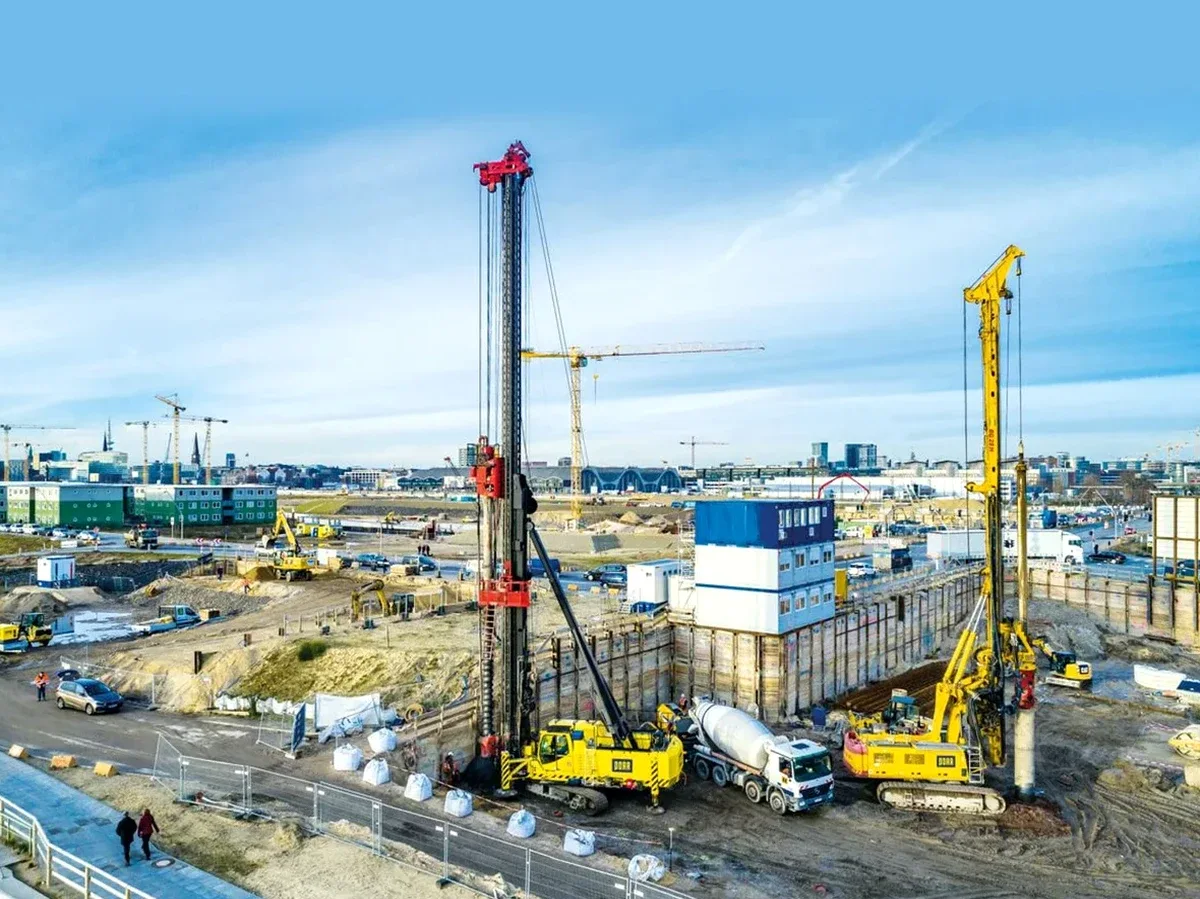
The pile rig itself tells you a lot about what's happening underground. When a hydraulic hammer rated for 60,000 ft-lbs starts getting refusal at 25 feet in a spot where the boring log said gravel at 35 feet, you know you've hit a cobble lens or an unexpected boulder — not uncommon in the older alluvial fan deposits that underlie much of Roseville. Skipping the pile load test program because 'the soils report looked fine' is the single most expensive mistake a developer can make on a deep foundation project here. We've been called in to forensic investigations where driven piles were terminated on what turned out to be a thin gravel stringer overlying softer silt, and the resulting differential settlement cracked slab-on-grade connections and racked door frames within two years. Placer County building officials are increasingly requiring both static load tests and PDA dynamic testing on production piles for Category III and IV structures, and for good reason. Expansive clay layers between 5 and 15 feet depth can generate uplift forces on pile caps that weren't accounted for in the original structural design, especially during the wet-dry seasonal cycles that characterize the Sacramento Valley climate. Our pile designs include explicit consideration of skin friction degradation in the expansive zone and lateral squeeze potential where adjacent fills or slopes create unbalanced earth pressures on pile groups.
Standards that apply
IBC 2022 (International Building Code) – Chapter 18 Soils and Foundations, ASCE 7-22 Minimum Design Loads for Buildings and Other Structures, ACI 318-19 Building Code Requirements for Structural Concrete, ASTM D1143 Standard Test Methods for Deep Foundations Under Static Axial Compressive Load, ASTM D4945 Standard Test Method for High-Strain Dynamic Testing of Deep Foundations, Caltrans Standard Specifications Section 49 (Driven Piles)
Complementary services
Axial and lateral pile capacity analysis
We compute ultimate and allowable capacities using both static formulas calibrated to site-specific soil parameters and wave equation analysis for driven piles. Lateral response is modeled in LPILE with p-y curves developed from actual SPT blow counts and lab strength data, not generic correlations. For projects within the City of Roseville jurisdiction, all calculations include seismic load combinations per ASCE 7-22 Chapter 12.
Pile load test program design and supervision
We specify the test pile locations, reaction system configuration, loading schedule, and instrumentation requirements for both static compression tests per ASTM D1143 and high-strain dynamic tests per ASTM D4945. Our team provides full-time field observation during testing and delivers the load-settlement curves and capacity interpretation within 48 hours of test completion.
Typical parameters
Quick answers
What type of pile is most commonly used in Roseville commercial construction?
For most commercial projects east of Highway 65, driven steel H-piles or closed-end pipe piles are the most common choice because the dense Pleistocene gravels are relatively shallow and supply excellent end-bearing capacity. West of Foothills Boulevard, where the alluvial deposits are deeper and groundwater is higher, auger-cast piles or drilled cast-in-place piles are often preferred to avoid caving soils and to reduce vibration during installation near existing structures.
What do pile foundation design services cost in Roseville?
For a typical commercial building in the Roseville area, pile foundation design solutions — including geotechnical investigation, capacity analysis, and construction recommendations — generally range from US$1,450 for a straightforward driven pile design on a small lot to US$5,690 for a more complex project requiring lateral load analysis, load test program design, and multiple pile types. The final cost depends on the number of borings, depth of investigation, and whether dynamic testing supervision is included.
How does seismic activity in Placer County affect pile foundation design requirements?
Placer County, including Roseville, is in a seismically active region with several mapped fault zones including the Bear Mountain fault system. Under IBC and ASCE 7 provisions, pile foundations must be designed for both inertial loading from the superstructure and kinematic loading from soil deformation during an earthquake. This requires lateral pile analysis considering liquefaction potential in saturated granular layers, degradation of soil stiffness at large strains, and potential for downdrag if loose sands densify during shaking. Our designs incorporate site-specific seismic hazard parameters from the USGS Unified Hazard Tool.