ASCE 7-22 seismic provisions and IBC 2024 requirements demand rigorous ground improvement when building in Roseville's unique alluvial environment. The city sits at approximately 164 feet elevation, where Quaternary deposits from the Dry Creek and Cirby Creek watersheds create zones of loose, compressible granular soils that can amplify seismic shaking. A vibrocompaction design that merely meets minimum code often proves insufficient once real site variability emerges during excavation. Our team develops densification layouts based on ASTM D1586 standard penetration resistance data, correlating blow counts with target relative density thresholds that satisfy both structural engineers and local building officials. When soft lenses appear within the granular matrix, we often integrate findings from CPT testing to refine depth targets and verify that the improved ground meets the 70% relative density benchmark required for seismic site class D transitions.
Effective vibrocompaction in Roseville requires matching vibrator frequency to the grain-size distribution curve, because poorly graded sands densify at lower energy input than well-graded mixtures.
Our approach and scope
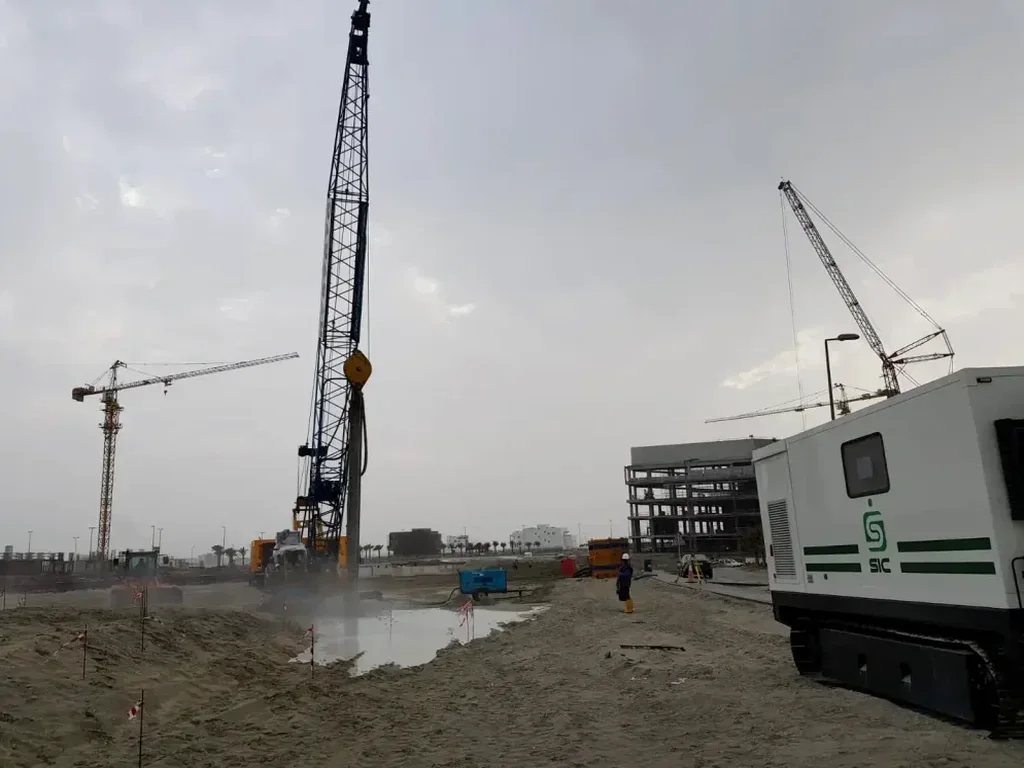
Local ground factors
Roseville's population crossed 155,000 in 2023, driving a construction wave that increasingly encroaches on areas mapped with moderate to high liquefaction susceptibility near the Pleasant Grove fault zone. The 2020 USGS National Seismic Hazard Model assigns a 0.45g peak ground acceleration for the 2,475-year return period at this latitude, meaning that loose saturated sands within 50 feet of grade face a real potential for cyclic mobility during a design-level event. A vibrocompaction design that skips post-treatment verification or relies solely on empirical charts without site-specific energy calibration can leave untreated columns between compaction points, creating preferential drainage paths that accelerate pore pressure buildup rather than mitigate it. The consequence is differential settlement that manifests within the first 30 seconds of strong shaking, cracking slab-on-grade floors and disrupting utility connections long before the structure itself reaches lateral capacity. Our designs include a minimum 10% redundancy in compaction point coverage and require cross-hole shear wave velocity profiling for projects on liquefiable soils deeper than 40 feet.
Standards that apply
ASCE 7-22 Minimum Design Loads and Associated Criteria for Buildings and Other Structures, IBC 2024 Chapter 18: Soils and Foundations, ASTM D1586 Standard Test Method for Standard Penetration Test (SPT) and Split-Barrel Sampling of Soils, ASTM D2487 Standard Practice for Classification of Soils for Engineering Purposes (Unified Soil Classification System), City of Roseville Building Division 2022 Geotechnical Investigation Guidelines
Complementary services
Liquefaction Mitigation Design
Grid layouts with energy calibration for loose sands below the groundwater table, referencing USGS seismic hazard curves specific to the Roseville 38.75°N coordinate and the Pleasant Grove fault scenario.
Post-Treatment Verification Testing
CPT and SPT correlation profiling at 5-point intervals across the treatment zone, with before-and-after relative density calculations submitted as a signed engineering report.
Gradation-Dependent Energy Optimization
Sieve analysis per ASTM D6913 to match vibrator frequency, probe diameter, and dwell time to the site-specific grain-size distribution, reducing over-compaction in well-graded soils.
Typical parameters
Quick answers
What does vibrocompaction design cost for a typical Roseville commercial lot?
For a standard 0.5-acre commercial parcel in Roseville, a complete vibrocompaction design package including SPT exploration, gradation analysis, grid layout, and post-treatment verification runs between US$1,390 and US$4,650 depending on treatment depth and the number of compaction points.
How deep can vibrocompaction treat the loose alluvial soils common along Dry Creek?
With extension tubes and a 180 kW vibrator, we routinely reach 85 to 100 feet depth. The Dry Creek alluvium typically shows treatable SP-SM sequences to about 60 feet, which falls well within standard equipment range without requiring bottom-feed stone columns.
Does the City of Roseville require post-treatment verification for vibrocompaction?
Yes. The 2022 Building Division guidelines mandate pre- and post-treatment SPT or CPT comparisons at a minimum of one test per 2,500 square feet of treated area, with results submitted as part of the foundation permit package.
Can vibrocompaction eliminate the need for deep foundations on a Roseville site?
When site conditions show clean to slightly silty sands with N-values below 15, vibrocompaction frequently raises bearing capacity above 4,000 psf, allowing spread footings to replace driven piles. We confirm this through settlement analysis using Schmertmann's method with post-treatment modulus values.
What is the minimum site access width required for vibrocompaction equipment?
A 130-ton crawler crane with vibrator probe needs approximately 22 feet of clear width and 65 feet of overhead clearance. For infill lots in older Roseville neighborhoods with narrower access, we evaluate smaller mast-mounted units that operate within 14-foot easements.