Roseville didn’t just spring up along the rail line—it spread across the floor of an ancient alluvial valley where Dry Creek and its older terraces left behind layered deposits of clay, silt, and loose sand. Anyone who has tried to drive a trench box through the deeper parts of the Antelope Creek corridor knows the ground shifts from stiff to soft faster than a crew can adjust the shoring. That variability is exactly why geotechnical analysis for soft soil tunnels becomes critical when the city needs to route utilities, storm drains, or transit infrastructure beneath active rail corridors and established residential neighborhoods. The subsurface here doesn’t read like a textbook; it reads like a history of flood deposits and decomposed granite wash from the Sierra foothills, which means tunnel face stability and crown settlement demand more than a generic desktop study. A proper field program—often starting with a test pit investigation to map the shallow strata directly—gives the engineering team a baseline before any tunneling parameter is selected.
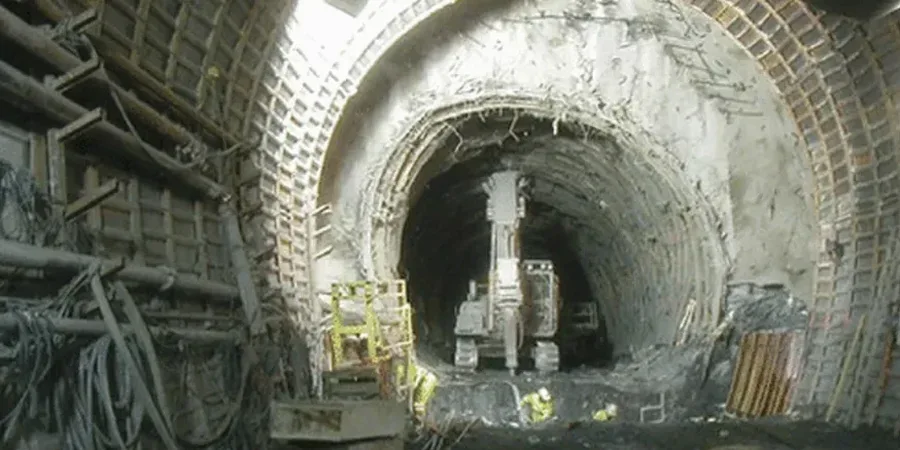
Low overburden in soft alluvium shifts the controlling failure mode from deep wedge stability to crown chimney collapse—a condition Roseville’s valley geology triggers more often than expected.
Our approach and scope
Local ground factors
Roseville sits in a moderate seismic setting—roughly 30 miles east of the Sacramento-San Joaquin Delta fault zone—but the real tunnel risk here is not just shaking. It is the combination of shallow groundwater, low-cohesion silt, and the legacy of unconsolidated Dry Creek flood deposits that can fluidize under cyclic loading. Even a magnitude 5.5 event on a local blind thrust could generate enough excess pore pressure in a silty sand lens to trigger face instability or a sudden loss of confinement, turning a stable heading into a running ground condition in seconds. The geotechnical analysis for soft soil tunnels in this area has to explicitly evaluate liquefaction susceptibility using Seed & Idriss simplified procedures applied to SPT blow counts from the tunnel horizon, and then feed those results into a deformation analysis that quantifies how much the liner might oval under lateral spreading. Without that step, the structural design is guessing. The International Building Code (IBC) and local Placer County amendments require a site-specific geotechnical investigation that addresses both static stability and seismic performance, and the report needs to stand up to peer review when the tunneling method moves from open-face to a pressurized-face TBM.
Standards that apply
IBC 2021 (with Placer County amendments), ASCE 7-22 Minimum Design Loads for Buildings and Other Structures, ASTM D1586 Standard Test Method for Standard Penetration Test (SPT) and Split-Barrel Sampling of Soils, ASTM D2487 Standard Practice for Classification of Soils for Engineering Purposes (Unified Soil Classification System), FHWA-NHI-10-034 Technical Manual for Design and Construction of Road Tunnels
Complementary services
Soft-ground tunnel geotechnical baseline report
We establish the geotechnical baseline for the tunnel alignment using exploratory borings, in-situ testing, and laboratory strength and consolidation data. The deliverable defines the ground behavior types, groundwater regime, face stability pressures, and settlement predictions that the contractor bids against. For Roseville’s mixed alluvial conditions, the report includes explicit trigger levels for TBM operating parameters and contingency measures for running or flowing ground.
Construction-phase instrumentation and monitoring
We design and implement the monitoring plan—surface settlement points, in-tunnel convergence arrays, and piezometers—to track how the soft ground responds during excavation. The data feeds back into the observational method, allowing the support class to be adjusted in real time if the measured deformation exceeds the threshold defined in the baseline report. In Roseville’s shallow overburden sections, we also monitor adjacent rail ballast and pavement for early signs of trough development.
Typical parameters
Quick answers
What makes Roseville’s soil particularly challenging for soft-ground tunneling?
The main challenge is the stratigraphic unpredictability left by Dry Creek’s historical flood deposits. The tunnel horizon often intercepts interbedded clay, silt, and loose sand lenses that hold perched groundwater. The transition from stiff alluvium to weathered granitic residuum can occur within a single ring length, creating mixed-face conditions that require constant adjustment of face support pressure.
How much does a geotechnical analysis for a soft soil tunnel typically cost in the Roseville area?
The fee depends on the tunnel length and the required investigation depth, but for most municipal utility or transit tunnels in the Roseville corridor, the geotechnical analysis ranges between US$4,430 and US$16,670. That covers the field investigation, laboratory testing, and the baseline report with settlement and face stability calculations.
Which laboratory tests are essential for a soft-ground tunnel design here?
At a minimum, we run unconsolidated-undrained triaxial tests for short-term clay strength, one-dimensional consolidation tests to estimate settlement and liner loads, and Atterberg limits plus grain size distribution to classify each stratum correctly. When liquefaction is a concern, cyclic triaxial or cyclic simple shear tests may also be warranted.
Do you handle the geotechnical monitoring during tunnel construction, or just the pre-design investigation?
We cover both phases. The pre-design investigation produces the geotechnical baseline report, and during construction we install and read the instrumentation—surface settlement points, inclinometers, and piezometers—and help the contractor apply the observational method to adjust support classes as real ground conditions are revealed.
How is the risk of ground collapse managed in shallow Roseville tunnels?
Risk management starts with a detailed geotechnical model that maps every soft layer and perched water zone along the alignment. From that model we predict the settlement trough and define maximum allowable face relaxation. During construction, real-time monitoring triggers contingency measures—such as face breasting or grouting—well before a chimney collapse can propagate to the surface.