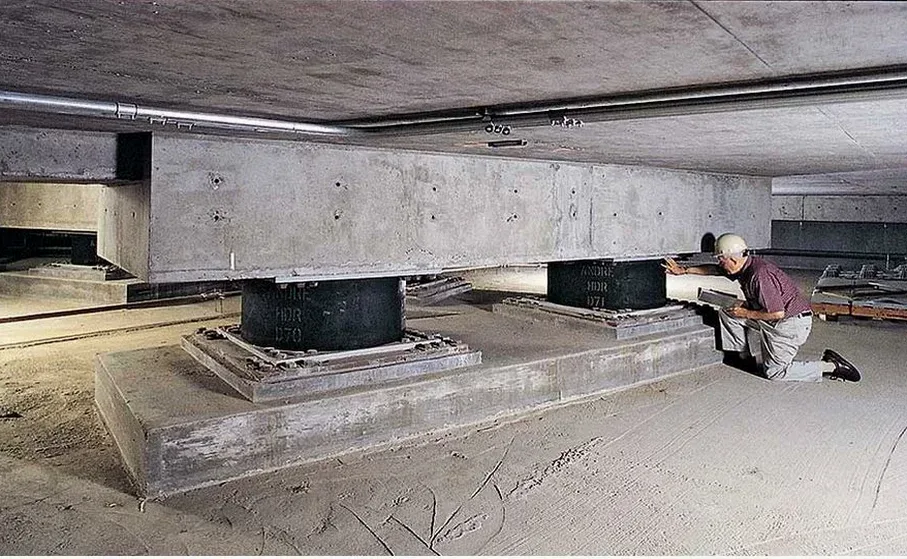
The installation crew positions the elastomeric bearing on the lower pedestal with millimeter precision, checking the level against a digital inclinometer as the Roseville afternoon sun glints off the steel shim plates. Each isolator in the array must sit within a tolerance envelope tighter than what most foundation contractors encounter on conventional projects. For buildings in Roseville, where the subsurface transitions from stiff Pleistocene alluvium near the Sierra Nevada foothills to deeper basin deposits closer to the Sacramento River, the performance of a base isolation system hinges on how accurately the ground motion parameters are characterized before the first bearing is ever cast. Our geotechnical team integrates site-specific shear wave velocity profiles with the ASCE 7-22 ground motion hazard maps for the 38.75°N latitude, ensuring the isolator properties match the spectral demands unique to this part of Placer County. This upfront characterization often pairs with a seismic microzonation study when the project spans multiple soil types across a single Roseville parcel, and we coordinate closely with the structural engineer to verify that the isolation period falls comfortably outside the predominant site period.
A properly tuned base isolation system in Roseville can reduce the seismic force demand on the superstructure by a factor of three to five compared to a fixed-base design, but only if the geotechnical characterization captures the site period within 0.1 seconds.
Our approach and scope
Local ground factors
Two sites in Roseville separated by only half a mile can demand fundamentally different isolation designs. A hospital campus near the Roseville Galleria typically sits on the moderately dense Pleistocene age Mehrten Formation, where the shear wave velocity in the upper 100 feet averages around 1,200 ft/s and the site period is relatively short: the isolation system can be tuned efficiently at around 2.8 seconds with manageable displacements. Contrast that with a fire station or data center proposed near the lower reaches of Dry Creek, where Holocene alluvium extends 60 to 80 feet deep and the average Vs30 drops into the 600 ft/s range: the same isolation period would produce MCE_R displacements easily exceeding 26 inches, demanding larger bearings, wider moats, and a complete rethink of the utility detailing. The difference in foundation cost between these two Roseville sites can reach six figures purely because of the soil amplification effect on the isolator displacement spectrum. Ignoring the deeper basin response at the second site is not an option: the IBC explicitly requires site-specific analysis when the site class is D and the structure is assigned to Risk Category IV, which applies to every hospital, emergency operations center, and critical infrastructure project in Roseville. We routinely benchmark our one-dimensional site response models against published NGA-West2 ground motion prediction equations to verify that the amplification factors are not underestimated, particularly at the longer periods where base-isolated buildings live.
Standards that apply
ASCE/SEI 7-22 Minimum Design Loads and Associated Criteria for Buildings and Other Structures, 2022 California Building Code (CBC), Chapter 17 (Special Inspections and Tests), IBC 2021, Section 1705.13 (Seismic Isolation), ASTM D4015 Standard Test Methods for Modulus and Damping of Soils by Resonant-Column Method
Complementary services
Site-Specific Ground Motion Hazard Analysis
We develop Roseville-specific uniform hazard spectra and conditional mean spectra using the USGS Unified Hazard Tool and local Vs30 measurements, providing the structural engineer with acceleration time histories matched to the ASCE 7 target spectrum for the exact latitude-longitude coordinate.
Isolator Prototype Testing and Oversight
Our engineers witness the full-scale dynamic testing of lead-rubber or friction pendulum isolators at the manufacturer's facility, verifying that the force-displacement loops meet the project-specific acceptance criteria for effective stiffness, characteristic strength, and damping ratio across three cycles of MCE_R displacement.
Nonlinear Response History Analysis Coordination
We prepare the geotechnical input parameters including strain-compatible shear modulus reduction curves and hysteretic damping ratios for the isolator soil springs, then collaborate with the structural analyst to confirm that the isolation system period is sufficiently separated from the fundamental site period.
Typical parameters
Quick answers
How much does base isolation seismic design cost for a Roseville project?
For a mid-rise essential facility in Roseville, the complete geotechnical and base isolation design package, including site-specific ground motion analysis, isolator testing oversight, and peer review coordination, typically falls between US$3,900 and US$8,610 depending on the number of ground motion records required and the complexity of the subsurface profile.
What soil conditions in Roseville make base isolation particularly beneficial?
Roseville's variable subsurface, with stiff Pleistocene terrace deposits near the foothills and deeper Holocene alluvium along the Dry Creek and Cirby Creek corridors, creates sharp contrasts in site amplification. Base isolation is especially advantageous on the softer Class D sites where the longer fundamental period of the isolated structure avoids the peak spectral acceleration that a fixed-base building would background.
Does ASCE 7 require site-specific analysis for base-isolated buildings in Roseville?
ASCE 7-22 Section 17.3.1 requires site-specific ground motion hazard analysis for all isolated structures assigned to Risk Category III or IV, and for any isolated structure on Site Class D, E, or F. Given that much of Roseville falls on Site Class D, most base isolation projects in the city will trigger this requirement regardless of occupancy type.
What is the typical construction timeline for installing base isolators in Roseville?
The isolator installation sequence, from casting the lower pedestals through grouting the upper plates and removing the temporary shoring, typically spans four to six weeks for a medium footprint building. This schedule assumes the foundation contractor has already completed the subgrade preparation and the pedestal rebar cages are pre-tied, and it includes the Roseville building department's special inspection hold points required under CBC Chapter 17.