Roseville sits on a complex alluvial plain where the deeply weathered granitic bedrock of the Sierra Nevada foothills transitions into valley sediments, creating soil profiles that can vary from well-drained sandy loams to expansive clay lenses within a single project site. The California Department of Transportation (Caltrans) requires precise subgrade strength values for any pavement design submitted for permitting—and that's where the laboratory CBR test becomes non-negotiable. Our AASHTO-accredited lab in the Sacramento metro area processes soaked and unsoaked CBR specimens under strictly controlled moisture and density conditions, delivering the bearing capacity ratios that geotechnical engineers need to calculate structural layer thicknesses per the Caltrans Highway Design Manual. We routinely support commercial developments along Pleasant Grove Boulevard and residential subdivisions in the West Roseville growth corridor, where the interface between the Mehrten Formation and younger floodplain deposits demands thorough mechanical characterization before asphalt or concrete sections are finalized.
A soaked CBR below 3% changes the pavement structural section entirely—what was designed as a standard arterial becomes a reinforced section with stabilization geogrid.
Our approach and scope
Local ground factors
A misstep we observe repeatedly in Roseville is the designer relying on an unsoaked CBR value for a pavement section that will sit beneath a drainage swale or a landscape area with automatic irrigation. The Mehrten Formation-derived soils common across the city's northeastern quadrant contain sufficient fines that saturation can reduce bearing capacity by forty to sixty percent compared to the as-compacted condition. When the laboratory CBR test skips the soaking phase—or when the soaking period is cut short—the resulting pavement design underestimates the required base and subbase thickness, leading to premature rutting and alligator cracking within the first five years of service. The Placer County Department of Public Works and the City of Roseville both review laboratory CBR submittals with this failure mode in mind, and they expect to see a properly soaked test result with full documentation of the compaction curve, moisture-density relationship, and swell measurement recorded during the saturation period.
Standards that apply
ASTM D1883 - Standard Test Method for California Bearing Ratio (CBR) of Laboratory-Compacted Soils, AASHTO T 193 - Standard Method of Test for The California Bearing Ratio, Caltrans Highway Design Manual, Chapter 630 - Flexible Pavement Design, ASTM D1557 - Standard Test Methods for Laboratory Compaction Characteristics of Soil Using Modified Effort, IBC Section 1803 - Geotechnical Investigations
Complementary services
Soaked CBR with swell measurement
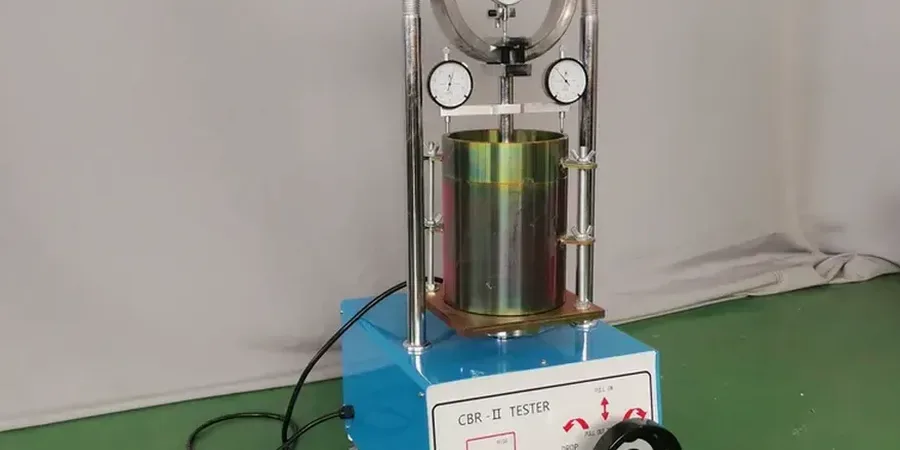
Three-point compaction curve per ASTM D1557 followed by specimen preparation at target density and a full 96-hour soak. We record vertical swell daily and report CBR at both 0.1-inch and 0.2-inch penetration, with stress-penetration curves included in the certified report.
Unsoaked CBR for immediate construction assessment
For project phases where the subgrade will be paved immediately and protected from moisture ingress, we perform unsoaked CBR testing within 24 hours of specimen compaction. This test supports temporary haul roads, construction staging areas, and fast-track commercial tenant improvements where the saturation timeline differs from permanent pavements.
Typical parameters
Quick answers
How many CBR specimens should I prepare for a Roseville commercial site?
For a typical commercial lot in Roseville, we recommend a minimum of three CBR specimens—each compacted at a different moisture-density point along the Proctor curve—so the laboratory can generate a CBR versus density relationship. If the site spans more than two acres or crosses mapped soil unit boundaries, additional specimens should target each distinct soil type encountered in the borings. Caltrans guidelines for roadway projects generally specify one CBR test per soil type per 2,000 linear feet of alignment.
What is the turnaround time for a laboratory CBR test?
Standard turnaround is five to seven business days from sample receipt, accounting for the four-day soaking period required by ASTM D1883. Unsoaked CBR results can be delivered within two business days. Rush processing is available for projects facing permit deadlines, and we coordinate directly with the Roseville building department plan check timeline when needed.
Do you pick up soil samples from the Roseville area or do we deliver them?
Both options are available. Our laboratory is located within the Sacramento metropolitan area, and we can arrange sample pickup from Roseville drill sites—typically same-day or next-morning depending on the drilling schedule. Samples must be sealed in moisture-tight containers and labeled with project name, boring number, depth interval, and soil description per ASTM D4220 requirements for undisturbed or recompacted specimens.
What is the cost of a laboratory CBR test in Roseville?
A single-point soaked CBR test with compaction curve typically ranges from US$110 to US$210, depending on whether the Proctor compaction is performed separately or as part of the CBR specimen preparation. Multi-point CBR programs—where we test at three moisture-density conditions—supply a CBR envelope for design optimization and are priced accordingly. We supply a project-specific quote once we review the boring logs and the number of soil types requiring characterization.
What CBR value does Caltrans require for residential streets in Placer County?
Caltrans and Placer County standards generally require a design CBR based on the soaked laboratory value at 95% relative compaction. For local residential streets, a soaked CBR of 3% or higher is typically considered adequate for flexible pavement design with an appropriate aggregate base, though the structural section thickness increases significantly as CBR drops toward the 3% threshold. Values below 3% usually require subgrade stabilization with cement or lime treatment, or a geogrid-reinforced base layer, before pavement construction proceeds. More info.