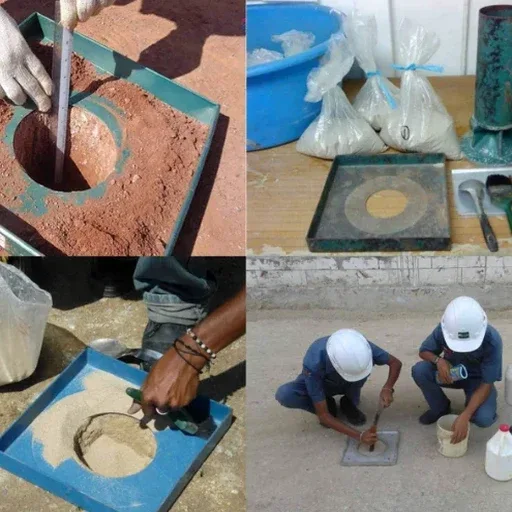
In Roseville, where the transition from the Central Valley floor to the Sierra foothills creates highly variable alluvial deposits, meeting the compaction requirements of IBC Chapter 18 and Caltrans Standard Specifications is not just paperwork — it is the difference between a pavement that lasts and one that fails within two seasons. Our laboratory performs field density testing using the ASTM D1556 sand cone method across subdivisions north of Pleasant Grove Boulevard, commercial pads along Douglas Boulevard, and utility trenches in new industrial parks. The procedure is straightforward in principle: we excavate a small hole, measure its volume with calibrated Ottawa sand, and compare the in-place dry density against the maximum dry density from a modified Proctor test (ASTM D1557). But the real value comes from reading the soil fabric on-site — distinguishing a clean decomposed granite fill that compacts predictably from a silty clay borrowed from a nearby creek bed that requires moisture conditioning. We integrate these observations with grain size analysis to confirm the material meets specification, and when contractors need structural verification beneath footings, we coordinate with plate load testing to supply modulus values for the geotechnical engineer of record.
Compaction in Roseville's Mehrten Formation fills is less about effort and more about moisture — achieving the right water content prevents latent collapse.
Our approach and scope
Local ground factors
Roseville's growth since the 2000s pushed residential subdivisions into areas where the natural soil profile includes expansive clay lenses near the Pleasant Grove Creek drainage and loose silty sands on the eastern bench toward Rocklin. Skipping field density verification in these zones — or relying solely on observation — carries real financial exposure: settlement of shallow utilities, cracked flatwork, and failed compaction tests during final inspection that halt project close-out. The permitting process under the City of Roseville Building Division and Placer County Environmental Health requires compaction reports stamped by a licensed geotechnical engineer, and incomplete records trigger re-testing at the contractor's expense. When the tested lift includes moisture-sensitive material, we also recommend Atterberg limits testing to flag expansive potential before the pavement section is placed, preventing warranty claims that can surface years after the certificate of occupancy is issued.
Standards that apply
ASTM D1556 — Standard Test Method for Density and Unit Weight of Soil in Place by Sand-Cone Method, ASTM D1557 — Standard Test Methods for Laboratory Compaction Characteristics of Soil Using Modified Effort, ASTM D698 — Standard Test Methods for Laboratory Compaction Characteristics of Soil Using Standard Effort, IBC Chapter 18 — Soils and Foundations (compaction and fill acceptance criteria), Caltrans Standard Specifications Section 19 — Earthwork
Complementary services
Sand Cone Density Testing
ASTM D1556 field density test with calibrated Ottawa sand, performed on structural fill, trench backfill, and subgrade. We supply immediate dry density and relative compaction results so the grading crew can adjust roller passes or moisture before the next lift.
Laboratory Proctor Compaction Curves
Modified Proctor (ASTM D1557) or standard Proctor (ASTM D698) compaction curves developed on representative bulk samples from the Roseville site. The maximum dry density and optimum moisture content become the benchmark for all field density acceptance.
Compaction Verification for Pavement Subgrade
Targeted testing at the top of subgrade prior to aggregate base placement, coordinated with CBR testing when the pavement design requires a soaked strength value for the structural section.
Typical parameters
Quick answers
How much does a sand cone density test cost in Roseville?
Field density testing using the sand cone method in the Roseville area typically ranges from US$90 to US$140 per test, depending on the number of tests scheduled on the same day, travel distance within Placer County, and whether laboratory Proctor data is already available. We supply a firm unit rate before mobilizing so there are no surprises in the compaction report package.
What is the difference between a sand cone test and a nuclear gauge test?
The sand cone method (ASTM D1556) directly measures soil volume by excavating a small hole and filling it with calibrated sand of known density, which makes it the referee method when nuclear gauge results are in question. A nuclear density gauge offers faster readings but requires a calibration curve built from sand cone tests on the same soil, and it is subject to regulatory requirements for radioactive material handling that the sand cone avoids entirely.
How many density tests does the City of Roseville require for a commercial building pad?
Under IBC Chapter 18, the minimum frequency is one field density test per 2,500 square feet per lift, with additional tests required where material type or compaction method changes. For utility trenches within the public right-of-way, Roseville Public Works generally follows a minimum of one test every 150 linear feet per lift. We coordinate directly with the project's geotechnical engineer of record to ensure the testing plan meets both the code minimum and any project-specific recommendations.