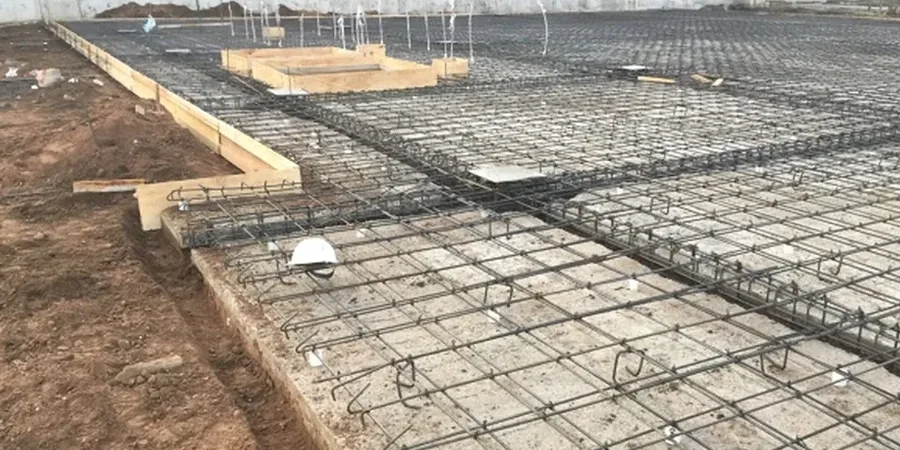
In Roseville we see a lot of slabs that fail early, not because the concrete was bad, but because the soil report didn't translate into a foundation that could handle the movement. The clay-rich soils across western Placer County, especially in older neighborhoods near the Southern Pacific rail corridor and newer subdivisions east of Fiddyment Road, can shrink and swell by a couple of inches between wet winters and 100-degree summers. That differential volume change is what tears a conventional slab apart. A properly designed raft or mat foundation bridges those soft spots and stiff zones, distributing column loads across a rigid plate so no single point settles more than the adjacent one. We size the mat thickness, reinforcement, and stiffening beams after running the numbers on the actual site stratigraphy, not a generic assumption. For sites with marginal bearing near the Linda Creek drainage, we often pair the raft design with results from a CPT test to get a continuous profile of tip resistance and sleeve friction before we commit to thickness and depth of embedment.
A mat foundation in Roseville must be stiff enough to span soft lenses in the vadose zone and flexible enough to move with the entire soil mass during a seismic event.
Our approach and scope
Local ground factors
The soil profile in the western Roseville neighborhoods along Pleasant Grove Creek is nothing like the drier, coarser material you hit up toward the Sunset Industrial Area. In the creek-adjacent tracts you often encounter 8 to 15 feet of soft, high-plasticity clay with a PI above 30, sitting on dense alluvium. A mat foundation on that profile has to be thick enough to limit total settlement and stiff enough to keep the angular distortion between columns below 1/480, which is the threshold where drywall and brick veneer start showing distress. In the eastern bench areas the risk shifts: the decomposed granite can be excellent bearing material when dry, but it loses strength fast if a broken irrigation line or poor drainage saturates the subgrade after construction. We model both drained and undrained conditions and check the mat's flexural and punching shear capacity against the worst-case scenario. Ignoring the seasonal groundwater rise that happens after a series of wet winters in the Sacramento Valley is how you end up with a structurally sound mat that nonetheless tilts half an inch over a 40-foot span and binds every door in the house.
Standards that apply
IBC 2021 (International Building Code), Chapter 18 – Soils and Foundations, ASCE 7-22 Minimum Design Loads and Associated Criteria for Buildings and Other Structures, ACI 318-19 Building Code Requirements for Structural Concrete, ASTM D2487 Standard Practice for Classification of Soils for Engineering Purposes, ASTM D1586 Standard Test Method for Standard Penetration Test (SPT) and Split-Barrel Sampling
Complementary services
Mat Foundation Sizing and Analysis
We determine slab thickness, rib layout, and reinforcement schedules using finite element models calibrated to site-specific subgrade modulus values. Every design package includes bearing, settlement, and overturning checks under both service-level and seismic load combinations per ASCE 7.
Expansive Soil Mitigation Design
For high-PI clays common in western Roseville, we design moisture barrier systems, deepened edge beams, and underslab drainage layers that reduce seasonal heave by controlling water migration. We specify the gradation and compaction requirements for the capillary break layer.
Subgrade Investigation and Testing
We coordinate CPT soundings, test pits, and laboratory classification to build the geotechnical model that feeds the mat design. Without this data, any mat is just a guess. We test at column locations, not just at the center of the pad.
Typical parameters
Quick answers
What does a mat foundation design cost for a project in Roseville?
For a residential or light commercial project in Roseville, a complete mat foundation design package typically runs between US$990 and US$4,440, depending on the slab area, number of stiffening ribs, and whether we need to run a full FEM model for irregular column grids. The price includes the subgrade reaction analysis, structural calculations, and stamped drawings ready for submission to the City of Roseville Building Division.
When is a mat foundation better than isolated footings in the Roseville area?
A mat becomes the better choice when the allowable bearing pressure of the native soil is below 2,000 psf, when column spacing is tight enough that individual footings would overlap, or when the soil profile includes expansive clays that will cause differential movement between isolated footings. In much of western Roseville, the combination of low bearing and high swell potential pushes the economics toward a mat early in the design process.
How deep do you place the mat foundation relative to the expansive soil zone?
We set the bottom of the mat and its edge beams below the zone of seasonal moisture fluctuation, which in Roseville typically means a minimum of 30 inches below finished exterior grade. For sites with extremely high PI values, we may deepen the edge beams to 48 inches and add a moisture barrier extending horizontally outward. The goal is to isolate the slab support from the upper soil layer that shrinks and swells every year.
Can you design a mat foundation for a site with liquefaction potential?
Yes. If the geotechnical investigation identifies liquefiable layers within the upper 50 feet, we incorporate the reduced subgrade modulus and lateral spreading demands into the mat design. The mat functions as a rigid raft that bridges localized zones of strength loss, but we also evaluate whether ground improvement such as vibrocompaction or stone columns is needed before the mat is constructed. We follow the liquefaction assessment procedures in ASCE 7-22 and the recommendations from Seed and Idriss for the Sacramento Valley region.