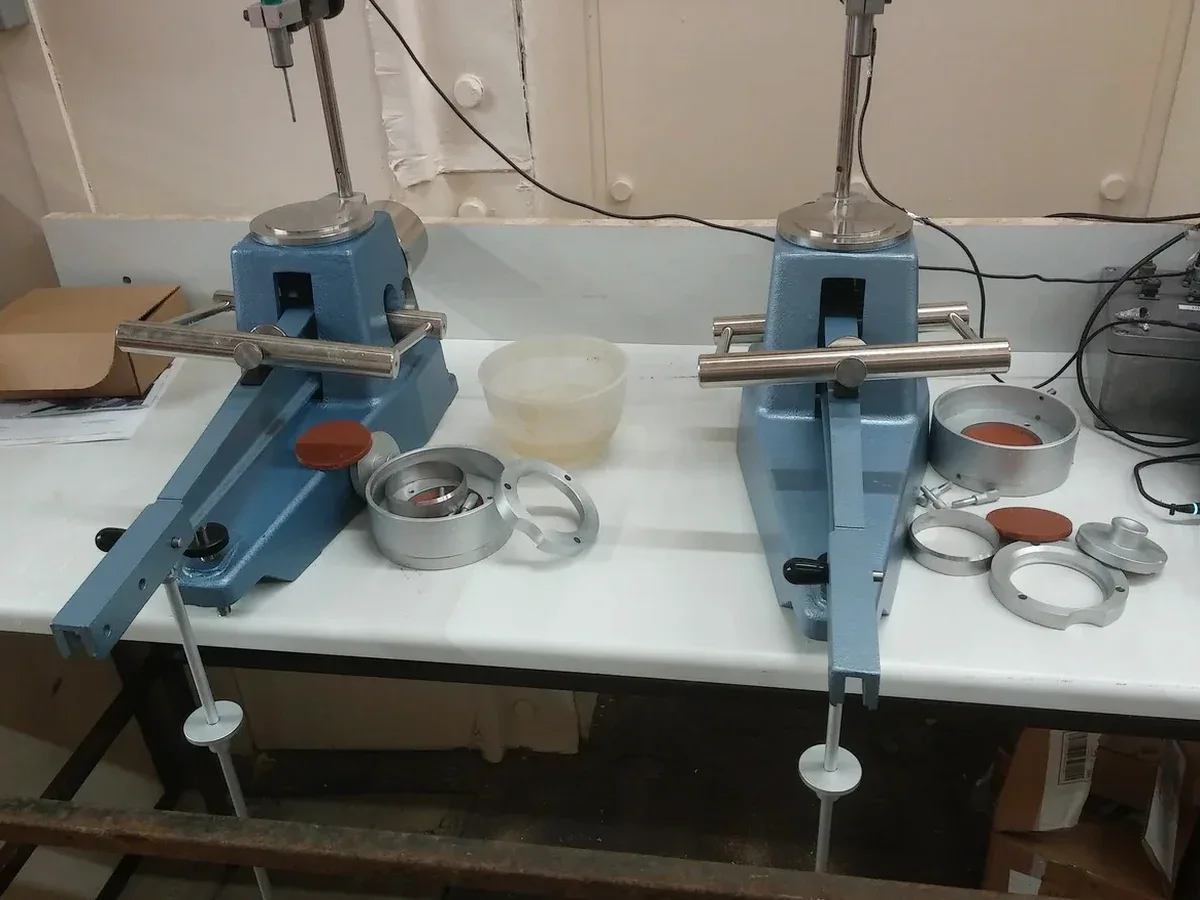
Roseville sits on a geological transition where the Central Valley meets the Sierra Nevada foothills, creating soil profiles that shift dramatically across short distances. The dry summer heat, which regularly exceeds 100°F, pulls moisture from near-surface clays and can mask expansive soil behavior until winter rains arrive. When contractors break ground in neighborhoods like Westpark or near the Galleria mall, they often encounter silty clays that look stable in August but turn problematic by January. This is where precise Atterberg limits testing becomes indispensable. By measuring the liquid limit and plastic limit under controlled conditions per ASTM D4318, our team identifies whether a soil will behave as a solid, a semi-solid, or a plastic material across the moisture spectrum. For earthwork specifications in Roseville, where the Placer County grading ordinance demands rigorous documentation, understanding the plasticity index is not optional — it provides the numerical basis for classifying fine-grained soils and predicting their volume-change potential throughout the wet-dry cycles typical of this region. Complementing the classification work, many projects also require a grain-size analysis to confirm the full particle distribution before foundation design proceeds.
A plasticity index above 25 in Roseville's clay-rich alluvium signals moderate to high expansion potential — data that directly influences foundation depth and reinforcement requirements.
Our approach and scope
Local ground factors
The most expensive mistake we see in Placer County is a geotechnical report that assigns a generic expansion index to Roseville soils without running the actual Atterberg tests. Some consultants rely on visual-manual classification — "looks like a lean clay" — and estimate the plasticity index from background elsewhere in the Central Valley. This shortcut backfires when the site turns out to have thin lenses of fat clay from an old stream channel that nobody cored. The result: footings designed for PI=15 that actually sit on PI=35 material, leading to differential heave within the first three rainy seasons. The repair costs on a single-family residence can exceed $40,000, not counting the litigation that follows. Our lab has received samples from Roseville projects where the owner demanded a second opinion after cracks appeared, and the Atterberg numbers told the real story within 48 hours. A proper plasticity analysis, combined with a liquefaction assessment when the site is near the Pleasant Grove fault zone, provides the defensible documentation that structural engineers need to justify their foundation recommendations.
Standards that apply
ASTM D4318-17e1 (Standard Test Methods for Liquid Limit, Plastic Limit, and Plasticity Index of Soils), ASTM D2487-17e1 (Standard Practice for Classification of Soils for Engineering Purposes — Unified Soil Classification System), ASTM D2216-19 (Standard Test Methods for Laboratory Determination of Water Content of Soil and Rock by Mass), CalGreen Code / CBC Chapter 18 (Soils and Foundations — expansive soil identification), Placer County Land Development Manual (soil report requirements for subdivision grading)
Complementary services
Full Atterberg Suite (LL, PL, PI)
Complete liquid limit, plastic limit, and plasticity index determination on disturbed samples. We run the multi-point Casagrande method with a minimum of four moisture contents to define the flow curve, reporting results on the same day oven-drying finishes.
One-Point Liquid Limit Screening
For large subdivision projects in Roseville with hundreds of samples, the one-point method per ASTM D4318 Annex A provides a cost-effective screening option. We validate the correlation factor on representative samples before applying it batch-wide.
USCS Classification Package
Combined Atterberg limits, sieve analysis, and visual description to assign the full Unified Soil Classification System symbol. Includes the group name per ASTM D2487 and commentary on expected engineering behavior for Placer County soils.
Typical parameters
Quick answers
How much does Atterberg limits testing cost for a Roseville residential project?
For a standard liquid limit and plastic limit test on a single sample, the fee ranges from US$50 to US$100 depending on whether you need the full multi-point curve or a screening test. Larger projects with bulk sample quantities typically qualify for reduced per-sample pricing. The report includes the flow curve plot, all raw moisture content data, and the final LL, PL, and PI values in a format ready for your geotechnical report appendix.
What is the difference between liquid limit and plastic limit, and why do both matter for my Roseville building site?
The liquid limit marks the moisture content where the soil transitions from a plastic state to a liquid state and starts flowing under repeated percussion. The plastic limit is the moisture content where the soil loses its plasticity and begins crumbling when rolled into 3 mm threads. The numerical difference between them — the plasticity index — quantifies the range of moisture over which the soil behaves plastically. In Roseville, a high PI means the soil has a wide moisture window where it can deform without cracking, which translates directly to higher shrink-swell potential and greater risk for slab-on-grade foundations during our pronounced wet-dry seasonal cycle.
How long does a typical Atterberg limits test take from sample drop-off to report?
Most Roseville projects receive results within 2 to 3 business days after the sample arrives at our lab. The limiting step is the oven-drying phase for moisture content determination, which runs overnight per ASTM D2216. If the project schedule is tight, we can expedite the liquid limit portion using the one-point method on the same day, with the full multi-point confirmation following the next day. We coordinate sample pickup logistics throughout Placer County to minimize transit time.